
|
Getting your Trinity Audio player ready…
|
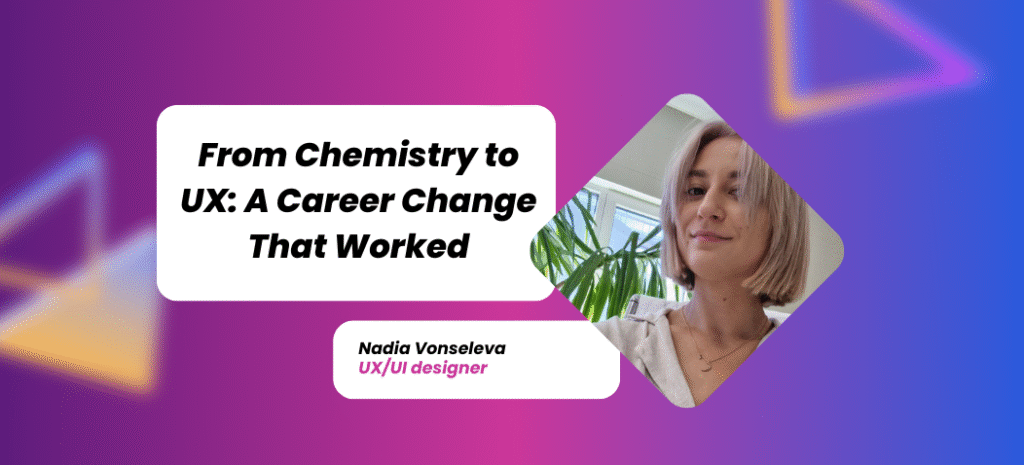
Career change rarely looks linear – and confidence doesn’t appear overnight.
This is a story of a full pivot into UX/UI design, guided by mentorship, structure and real-world feedback. From uncertainty and “where do I even start?” to landing a first role and owning a new professional identity, this Acceleration Program alumna Nadia Vonseleva shares what the journey actually looked like.
Before applying to the Women Go Tech Acceleration Program, where were you professionally and mentally?
When I applied to the Women Go Tech Acceleration Program, I was finishing a 6-month web design course at BIT. Before that, I worked in chemistry, so it was a full career change into UX/UI design.
During the courses, I became sure that I had chosen the right direction. I really wanted to work in this new field. At the same time, I was worried because the market felt very crowded. I had only courses and a few study projects, and I knew how hard it can be to find a first job without real experience.
I understood that I needed more than theory. I wanted to learn how this industry really works from people who already had experience. I lacked honest, objective feedback on my projects. I wanted to understand what is truly expected from a junior-level designer, how interviews work, how to handle difficulties mentally, and where and how to look for a job.
I didn’t really have fear or doubts. I had one main question: How do I find a job and become in demand?
What made you choose the Acceleration Program specifically, instead of learning on your own or joining another course?
I heard about the program from other people who were also changing careers. They recommended it to me.
I felt that learning on my own would not give me what an experienced mentor could. Learning from someone with real experience is simply much faster and more effective than doing everything alone. Since I had just finished courses, I didn’t need another course — I needed guidance, support, and direction.
Women Go Tech was the only program I already trusted because of strong recommendations. I expected help with creating a clear 6-month development plan and support in following it. I also expected feedback on my projects, practical advice, and emotional support.
How would you describe your mentorship relationship with your mentor?
The connection with my mentor, Valeria, worked from the very first day. We were both focused on results. I really appreciated her responsibility, structure, and kindness.
At the beginning, we created a clear development plan: what topics to cover and what to work on. At the end of every call, we agreed on the next topic and what each of us needed to prepare.
Can you share a moment or pattern during your weekly calls that really stayed with you?
There was also a funny pattern: almost every call started with me saying, “I have good news!”
The news was different every time — interview invitations, completed test tasks, new projects, finishing my portfolio, posting on social media and getting reactions, finding a remote job, moving to an office, even moving to another city.
There were failures too, and I shared those as well — but usually in a positive way, because bad experience is still experience.
You described the sessions as “mini therapy focused on design.” What did that emotional support change for you?
This sharing created a light, motivating atmosphere, and we talked almost every week. That’s why I called it “mini therapy focused on design.”
When I shared my progress, Valeria supported me, gave advice, and was genuinely happy for me. If I had kept everything inside, I wouldn’t have noticed how much progress I was actually making.
At what point did you start feeling that the process was actually working?
I really felt a breakthrough when I wrote a Facebook post saying that I was looking for a job in a UX designers group.
I knew that employers care a lot about how you think and how you work, not just final results. Around that time, I saw a LinkedIn repost from Valeria about a woman who found a job thanks to her cat. I was shocked and thought, “Is this a joke?”
Then I looked at my own cat and thought, “Why not?”
I wrote a post and added a photo of my workspace with my cat. And suddenly — people started offering work and collaborations in the comments and private messages. I was shocked.
What changed the most for you compared to before the program?
The biggest change was internal. I believed in myself much more. I realized that I can shape my own life. If you truly want something and act, it is possible.
How does this new chapter feel compared to where you started?
The first month felt unreal. A new city, a new job, a new life. Later, awareness came — and pride. I allowed myself to relax and enjoy what I was doing.
I often catch myself thinking at work:
“Yes, this is it. I’m not a chemist anymore — I’m a designer. And I’m happy.”
How would you describe the value of mentorship?
A mentor is like a psychologist. You can figure things out alone, but you can’t fully see yourself from the outside or help yourself where you’re stuck.
I also believe that support from close people is extremely important. I wouldn’t have made this career change without my husband’s support. I don’t give him credit for all my achievements, but I believe it’s important to acknowledge those who stood behind you every day.
What would you say to someone who feels ready for change but is still afraid?
If someone is afraid to take the first step, I would say: understand why you’re afraid. I was afraid too — for about 1.5 years before changing careers. What helped me most was my husband’s support. He saw how unhappy I was and reassured me that we could handle the transition financially.
It’s important not to act blindly. You need to realistically understand your situation and possibilities. But if you can handle the change — start with small steps. Step by step, everything begins to move.