
|
Getting your Trinity Audio player ready…
|
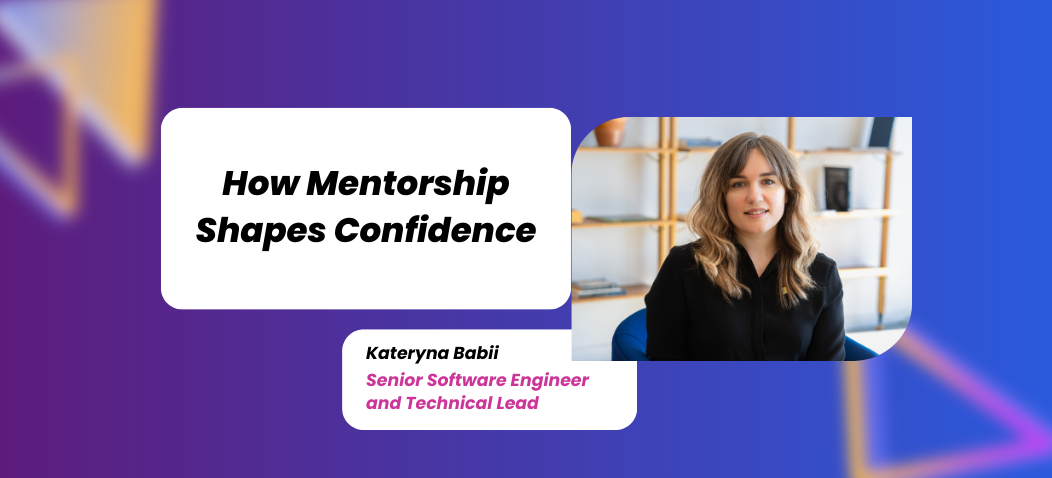
What does real mentorship in tech look like – beyond advice and good intentions?
In this interview, Kateryna Babii, a Senior Software Engineer and Technical Lead with 14+ years of experience shares how mentoring at Women Go Tech helps build confidence, think in systems and grow into industry-ready professionals.
Drawing from years of working on mission-critical healthcare and fintech platforms, she offers practical insights into the challenges women face in tech – and how structured guidance can turn uncertainty into clarity and long-term growth.
Can you briefly introduce yourself and describe your current role and area of expertise?
I am a Senior Software Engineer and Technical Lead with over 14 years of experience working on the modernization of mission-critical platforms in highly regulated industries, including healthcare and fintech. My background is in full-stack engineering, system architecture, and building secure, high-performance applications that operate reliably at scale.
Currently, I lead the technical transformation of major U.S. healthcare platforms serving more than one million users. My role focuses on designing and delivering end-to-end solutions that improve clinical workflows and data accessibility while meeting strict federal standards for security and accessibility. More than anything, my work is about building systems that people can trust – ensuring the reliability and integrity of platforms that support healthcare delivery at a national scale.
What has your professional journey looked like so far, and what key moments shaped your career in tech?
I started my career as a frontend engineer and gradually grew into senior and technical leadership roles by taking ownership of increasingly complex and mission-critical systems. A key turning point was leading architectural work on high-stakes financial and healthcare platforms, where my design decisions directly affected millions of users and systems processing billions of dollars in transactions.
These experiences reshaped how I think about engineering – not just as writing code, but as a responsibility for building systems that must remain secure, reliable, and scalable over many years. Today, I focus on designing resilient architectures that organizations can safely depend on to operate critical platforms at national scale.
What were the biggest challenges you faced early in your career, and how did you overcome them?
Early in my career, one of the biggest challenges was working on systems where reliability was absolutely critical and even small mistakes could have serious consequences. In fintech and healthcare, the challenge is not only writing correct code, but designing systems that remain secure, stable, and responsive under heavy and unpredictable load.
I overcame this by developing a deep understanding of system performance, failure modes, and data integrity, and by introducing structured performance testing, monitoring, and reliability practices into the teams I worked with. Over time, this allowed me to significantly reduce system latency, improve stability, and help platforms consistently achieve high availability while processing large transaction volumes and serving millions of users. These experiences helped me transition from a senior developer into a technical leader responsible for architectural decisions on mission-critical systems.
Was there a turning point that significantly influenced your professional direction?
Yes – a major turning point for me was taking responsibility for the architecture of mission-critical platforms. Leading migrations from legacy systems to modern architectures, including microfrontend-based platforms, changed how I approached engineering. I moved from focusing mainly on feature delivery to thinking deeply about long-term scalability, maintainability, and system resilience.
That experience reshaped how I define impact as an engineer. Instead of measuring success only by what we ship, I began measuring it by how reliably a system performs over time and how safely organizations and users can depend on it.
What skills or experiences do you consider most critical to where you are today?
Architectural thinking, performance engineering, and learning how to balance technical excellence with real-world constraints have been central to my growth. Equally important has been working in highly regulated environments, where accessibility, security, and reliability are not optional but fundamental parts of every design decision.
These experiences taught me to think beyond individual features and focus on building systems that are safe, resilient, and trustworthy – systems that organizations and users can depend on in critical situations.
What motivated you to become a mentor in Women Go Tech?
I joined Women Go Tech because I truly believe that technical expertise should extend beyond individual projects and organizations. After many years of building production-grade systems and making architectural decisions in complex environments, I realized how valuable this experience can be for engineers who are just starting or transitioning into the field.
Mentorship felt like a natural way to give back – to share not only technical knowledge, but also practical guidance on how to grow with confidence and make thoughtful career decisions in a challenging industry. I also genuinely enjoy seeing people succeed – there is something very rewarding about helping someone overcome doubts, gain confidence, and watching their progress over time.
How would you describe your experience as a mentor in the current cohort?
My experience has been very rewarding and highly structured. I focus on helping mentees build not only technical skills, but also confidence in decision-making, architectural thinking, and long-term career strategy. The cohort is incredibly motivated, and my role is to help turn that motivation into sustainable, industry-ready growth.
What I enjoy most is seeing real progress – when someone begins to think more independently, gain confidence, and approach complex problems with clarity. Watching that transformation is one of the most meaningful parts of mentoring for me.
What do you find most rewarding about mentoring aspiring women in tech?
The most rewarding part is seeing mentees move from uncertainty to confidence – especially when they begin to reason about systems, trade-offs, and technical decisions independently. That moment marks the transition from simply learning tools to truly thinking like an engineer.
I also love seeing the excitement appear – the sparkle in their eyes when something finally clicks, when they start to feel confident, curious, and genuinely excited about learning. Watching someone go from doubt to enthusiasm, and then seeing how far they soar afterward, is incredibly motivating for me as a mentor.
What common challenges do you observe among mentees, and how do you support them in overcoming these?
Common challenges I see among mentees include imposter syndrome, fragmented technical knowledge, and uncertainty about career direction. Many talented engineers doubt themselves simply because they lack structure or clear guidance.
I support them by providing structured learning frameworks, real production examples, and honest, constructive feedback. Over time, this helps mentees replace self-doubt with evidence-based confidence, develop stronger technical reasoning, and gain the practical skills they need to move forward with clarity and confidence.
What advice would you give to women who are considering a career in tech or a career transition?
I always encourage engineers to focus on understanding how systems work, not just on learning specific tools or programming languages. When you understand the big picture – how data flows, how components interact, and how failures happen – you gain flexibility and confidence that lasts throughout your career.
In highly regulated fields like healthcare and fintech, this mindset is essential. Reliability, security, and performance must be built in from the start. In my mentoring, I emphasize these fundamentals to help engineers grow into thoughtful technical leaders who can design systems that organizations and millions of users can safely depend on at national scale.
If her perspective resonated with you and you’d like to connect, you can find Kateryna on LinkedIn here.