
|
Getting your Trinity Audio player ready…
|
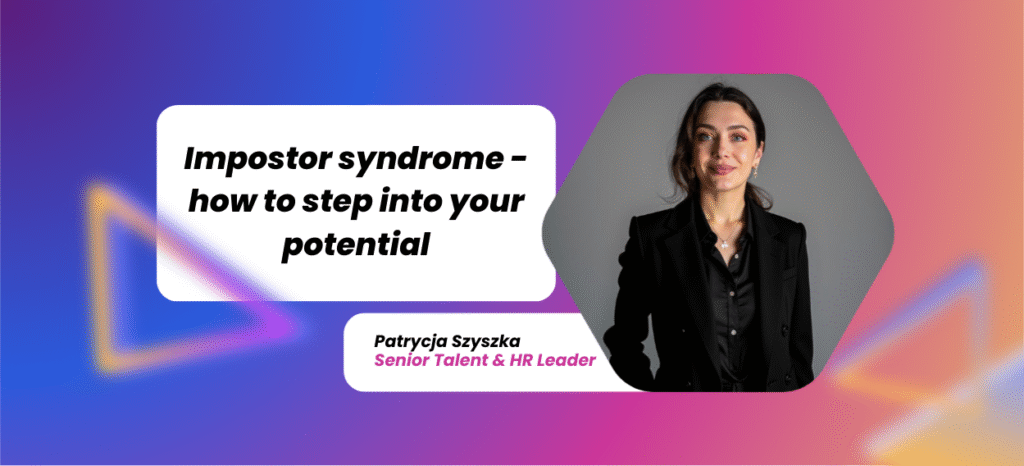
Based on our recent Women Go Tech webinar with Patrycja Szyszka, Senior Talent & HR Leader.
Why this topic keeps coming back (even when you’re doing well)
Impostor syndrome often shows up right when things are going “right”: a new role, a bigger project, higher visibility, or a stretch task you secretly wanted… And then your brain goes: “Cool. Now don’t mess it up.” Patrycja framed it as the fear of being “one mistake away” from being exposed – attributing wins to luck, timing, or “someone else would do it better.”
And here’s the tricky part: it’s not a one-time boss fight. It tends to reappear at every new level, because growth is inherently unfamiliar.
What impostor syndrome actually looks like (the pattern)
Patrycja broke it down into a loop that many of us recognize:
- Trigger: new role / new task / new expectations
- Anxiety: “I’m not good enough… they’ll find out.”
- Delivery + survival feeling: “I made it through.”
- Rationalization: “It worked because I got lucky.”
- Escalation: “Next time I won’t be lucky.”
Knowing the pattern matters, because it helps you label the experience as a cycle – not as proof that you’re an unqualified person who accidentally wandered into competence.
The “outsider effect” (and why it can become a self-fulfilling story)
One of the most practical insights: when you feel like you don’t belong, you often start acting like you don’t belong – staying quiet, stepping back, avoiding the center of conversations. Then others may read that as distance or lack of confidence. Patrycja’s point was simple: where you place yourself socially and professionally can shape how visible you become for opportunities.
This is especially relevant in male-dominated environments (including tech), where many women already fight for “permission” to take up space.
“Even executives?” Yes.
Patrycja referenced research showing impostor feelings are widespread – including at senior levels. She cited a KPMG stat that a large majority of women executives have experienced impostor syndrome and noted survey data in management contexts shared by CIPD.
The takeaway isn’t “great, it never ends.” The takeaway is: this feeling is not a reliable measure of your capability.
Patrycja’s story: promotion, pressure and the moment the data spoke louder than doubt
Patrycja shared a personal moment from earlier in her career: she joined a tech scale-up and within months she was promoted into leadership during a period of significant organizational change. Suddenly she was leading a growing team (eventually nine people), while internally feeling terrified that someone would realize she “wasn’t ready.”
What did impostor syndrome push her to do?
- Overprepare until exhaustion;
2. Avoid showing uncertainty;
3. Try to “prove” worth daily.
What helped her shift?
Making performance visible. She created clarity through KPI visibility so results weren’t just “nice feedback” – they were measurable outcomes.
Mentorship and honest proximity to senior leaders. Being in a mentoring space with senior women helped normalize that leaders are human, still learning and not perpetually “fully prepared.”
Her point: sometimes your mind treats uncertainty like danger. But uncertainty is often just… expansion.
4 tools you can use the next time impostor syndrome shows up
1) Build an “evidence file”
Create a doc (Notion, Google Doc, notes app – anything) where you keep:
- positive feedback (messages, emails, Slack screenshots)
- wins + outcomes
- projects you contributed to
- moments you handled well (especially the hard ones)
This isn’t “ego.” It’s an antidote to memory bias – because impostor syndrome selectively forgets your receipts.
2) Normalize discomfort (don’t treat it like a warning sign)
Discomfort often arrives before growth becomes familiar. Instead of “Am I good enough?”, try Patrycja’s reframe: “I’m learning.”
3) Shift from proving → contributing
Impostor syndrome screams: “Prove you deserve this.” A healthier question: “How can I support the team / customer / project today?” That switch reduces self-obsession and increases impact – and ironically, tends to build confidence faster.
4) Use external reality checks (don’t keep it silent)
Ask for specific feedback:
- your manager
- a teammate
- a mentor
- stakeholders you collaborate with
Patrycja also emphasized that silence makes impostor syndrome stronger. Saying it out loud to a trusted person often shrinks it to a workable size.
Q&A highlight: “Does it ever end?”
A participant asked if the feeling ever truly passes. Patrycja’s answer: it tends to return in different forms whenever you raise the bar – in work and in life (new tech stack, new responsibility, even major life changes). The practical goal isn’t to eliminate it forever; it’s to recognize it faster and respond with better tools.
Q&A highlight: “What if my role doesn’t have ‘hard skills’ I can measure?
Another participant asked how to assess competence (and communicate value) when outcomes are less quantifiable (e.g., customer success). Patrycja’s guidance:
- In interviews, hiring managers often evaluate mindset and learning – not just technical checklists;
2. Certifications can help confidence, but they’re not the whole story;
3. Focus on feedback, stakeholder outcomes, relationship-building and examples of how your work reduced pain points or improved retention/expansion.
A small action you can take today (10 minutes)
Open a blank note titled: “Evidence File – 2026”. Add:
- 3 things you delivered in the last month
- 2 pieces of positive feedback you received (or should have received)
- 1 situation you handled better than the “old you” would have
Future you will thank you. Loudly.