
|
Getting your Trinity Audio player ready…
|
Most people join mentorship for skills.
Some leave with something much bigger.
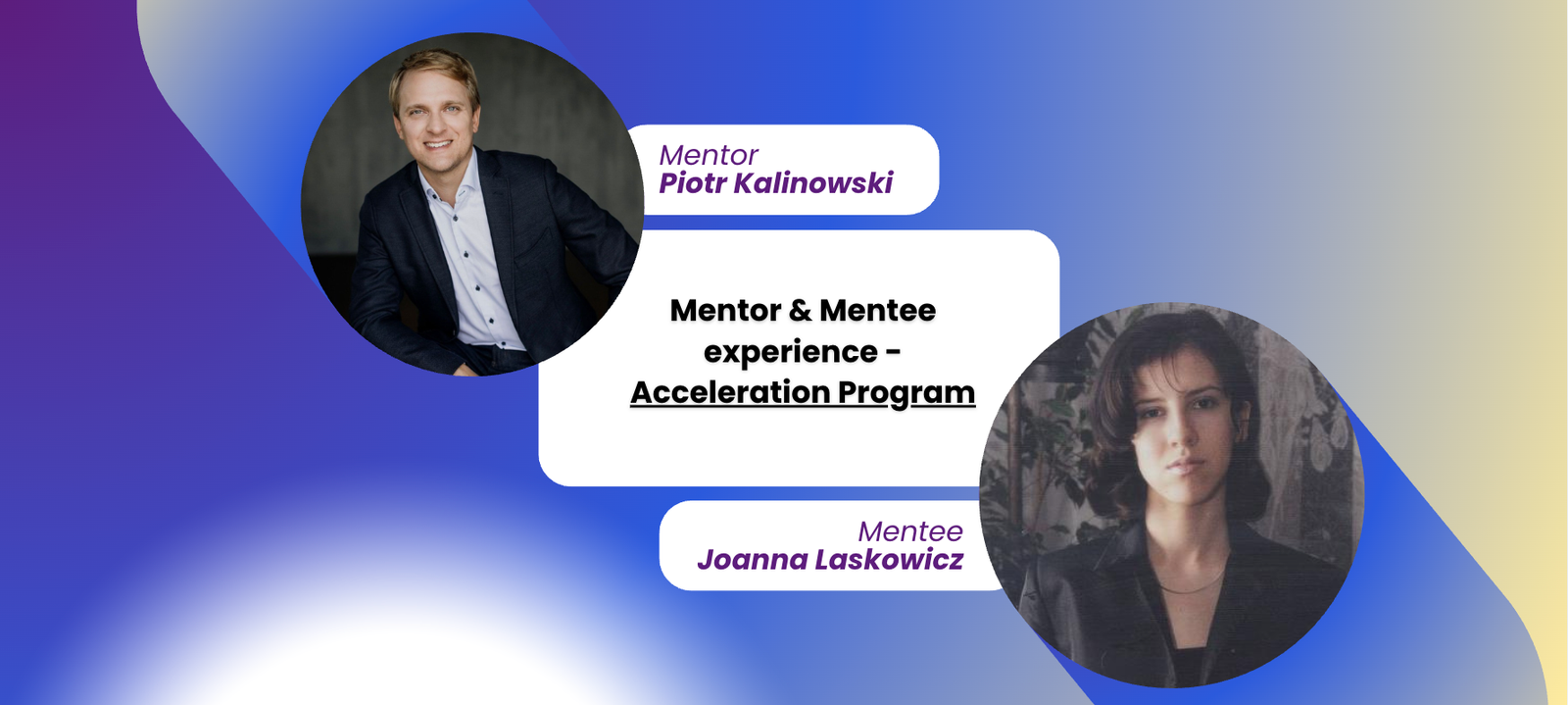
When Joanna entered the Women Go Tech Acceleration Program, she wanted a competitive edge in AI. What she gained – with mentor Piotr Kalinowski – was a shift in confidence, clarity and how she approaches her career. The kind of growth that’s not always comfortable, but actually moves things forward.
From daily recruiter messages to a completely new perspective, this story shows what happens when mentorship goes beyond advice – and both sides show up fully.
What advice would you give to future mentor–mentee pairs to make the most out of this experience?
Joanna: Choose the right mentor, trust the mentor, trust the process and the results will come. That may seem hard but it’s not the hardest part. This is: be prepared to hear the feedback you may not like- and learn about the harsh reality and to feel very uncomfortable and uncertain in the process. Give yourself time and remember that such a state is normal when you are going outside of your comfort zone. Learn to gain self-confidence by doing things you are uncomfortable with when you don’t feel like doing them at all. If you do that self-confidence, courage and drive will come just afterwards- as well as immense satisfaction and gratitude to yourself for giving yourself a chance.
Piotr: The most important foundation for a successful mentoring relationship is openness and trust. Without it, the collaboration stays on the surface level and misses its true potential.
What I’ve found most valuable — and what I’d encourage future mentors to embrace — is shifting from a purely advisory role to a more inquisitive one. Of course, sharing knowledge, answering questions, and giving guidance matters. But what makes the real difference is asking the right questions: What truly motivates you? What does success look like for you, not on paper, but in your everyday life? What are you afraid of? What have you been hesitant to say out loud?
These questions create space for the mentee to reflect deeply and articulate goals that are genuinely their own — not borrowed from job descriptions or social expectations. And once a mentor understands that real motivation, the advice they give becomes so much more targeted and meaningful.
For mentees, my advice would be: be honest, even when it feels uncomfortable. Your mentor is not there to judge you. The more authentically you show up, the more useful the relationship becomes.
And for both sides — treat the relationship as a partnership, not a hierarchy. The best mentoring conversations go both ways, and the trust you build together is what transforms a scheduled meeting into a genuinely transformative experience.
What made your collaboration particularly effective from the very beginning?
Joanna: I was guided by the most amazing Mentor – Piotr Kalinowski who apart from having an extensive professional experience and very high qualifications is a leader who guides, motivates and inspires by being a living example, a real role model. That makes his influence so much more powerful and even stronger then my own fear of certain changes. Piotr’s ability to listen, to understand, his incredible patience and wise feedback have completely changed my motivation and focus from comparing with everyone else and obsessing about not being good enough to being genuinely curious and passionate about AI, cloud and MLOps. That gives me drive to upskill more then 40 hours a week.
Piotr: Looking back, I think our collaboration was effective from the start because we got the fundamentals right — and we did it early. First, we established regular, scheduled meetings. Having a fixed rhythm meant that neither of us had to chase the other or wonder “when do we meet next?” It created a sense of commitment and accountability on both sides. The mentee knew she could count on dedicated time and attention, and that consistency built momentum.
Second, we invested time upfront in defining clear goals. Vague aspirations like “I want to grow professionally” don’t give you much to work with. We made sure to articulate concrete, meaningful objectives — which also made it easier to measure progress and stay motivated along the way.
Third — and this tied everything together — we built a solid plan. Having a roadmap meant our sessions had direction and purpose. We weren’t improvising from week to week; we had a structure to follow, and we could consciously adjust it whenever needed.In short, what made us effective wasn’t anything extraordinary — it was discipline and clarity. We treated the collaboration with the same seriousness you’d give a professional project, and that mindset paid off from day one.
How do you approach building trust and motivation with your mentees?
Piotr: For me, trust starts with honesty — and I mean that in both directions. I don’t soften feedback to the point where it loses its value, and I don’t pretend I have all the answers. I show up as I am, and I expect the same openness in return. In my experience, mentees sense very quickly whether they’re getting genuine engagement or polished performance — and only the former builds real trust.
But honesty alone isn’t enough. What I believe matters just as much is how you regard the person sitting across from you. I make a conscious effort to treat my mentee with full seriousness and respect — regardless of where she is in her journey, how much experience she has, or what gaps in knowledge she might have. The fact that someone is earlier in their path doesn’t make their ambitions, struggles, or questions any less legitimate.
I think this is something mentees feel deeply. When you are treated as someone whose perspective genuinely matters — not as a student to be corrected, but as a professional in the making whose voice deserves to be heard — it does something powerful to your motivation. It makes you want to rise to that level of respect.
So my approach is really quite simple: be real, and be respectful. No hierarchy, no performance. Just two professionals at different points in their careers, working together honestly toward a shared goal.
What tangible results have you seen so far in your career or opportunities since joining the program?
Joanna: Invitations from recruiters and new job offers are coming literally every day and new proposals of cooperations are waiting for me as soon as I am ready with my upskilling programs.
Mentor: What changes did you observe in your mentee’s confidence and focus over time?
Piotr: The most significant shift I observed wasn’t technical at all — it was a change in how my mentee understood the IT world itself.
When we started, she was very focused on deepening her technical skills, which is completely natural. That’s what most people entering or growing in IT tend to prioritize. But over the course of our collaboration, she had a real realization: technical competence alone is no longer enough to thrive in today’s IT environment.
She began to see that the ability to communicate clearly, collaborate across teams, navigate ambiguity, present ideas convincingly, and build relationships — these are not “nice to have” extras. They are core professional skills that often determine whether talented people are seen, heard, and given opportunities to grow.
Watching that awareness develop was genuinely exciting. With it came a noticeable shift in both her confidence and her focus. She became more intentional — not just about what she was learning technically, but about how she was showing up in professional situations. She started asking different kinds of questions, thinking more broadly about her career, and approaching challenges with a more well-rounded perspective.
That kind of growth — the kind that changes how someone sees themselves and the field they’re entering — is exactly what mentoring is for. And I think it will serve her far beyond anything we could have covered in a purely technical conversation.
What was the most surprising aspect of working with your mentor?
Joanna: Piotr’s ability to meet me where I was- i.e not ready for certain changes, strongly confused, very uncertain – and to start from there. He was very emphatic and understanding, he gave me time that I needed to adapt myself to changes- and in same case it took a lot of patience from him and a lot of time for me. It was difficult for me too – especially when what Piotr showed me was in conflict with my own beliefs. It’s one thing to agree with someone in theory another to put what you know in practice – especially when you are scared of unknown. It was hard but definitely worth doing.
Final thought
Growth like this doesn’t come from doing more – it comes from doing things differently, even when it feels uncomfortable. The right mentor won’t just guide you forward, they’ll help you see yourself differently along the way. And that shift? That’s where everything starts to change.